
Shopify says a bestselling SKU is running low. The 3PL portal shows enough units on hand. A marketplace reports a third available quantity. Yesterday’s spreadsheet had a fourth.
No one wants to make the wrong call. Marketing pauses an ad. Operations messages the warehouse. Someone exports another file. A decision that should have taken five minutes becomes a reconciliation exercise.
This is the moment inventory trust breaks.
At SuppliFlex, this is one of the operational challenges we are researching: how can teams understand, explain, and reconcile conflicting inventory numbers before making a decision?
For a growing Shopify-first brand, the problem is rarely a lack of inventory data. The problem is that different systems are answering different questions—and no one is certain which answer is safe to act on.
Inventory drift is a loss of context
Inventory drift happens when inventory numbers differ across systems and the team cannot clearly explain or reconcile the difference.
It rarely begins with one dramatic system failure. More often, it grows out of ordinary operational events:
A warehouse receives inventory, but the receiving update has not reached every system.
Units are reserved for a wholesale order while another channel still treats them as available.
A return is physically back in the building but has not been inspected or released for sale.
A manual adjustment is made in one system but not reflected elsewhere.
A bundle, transfer, damaged unit, or safety-stock rule changes what can actually be sold.
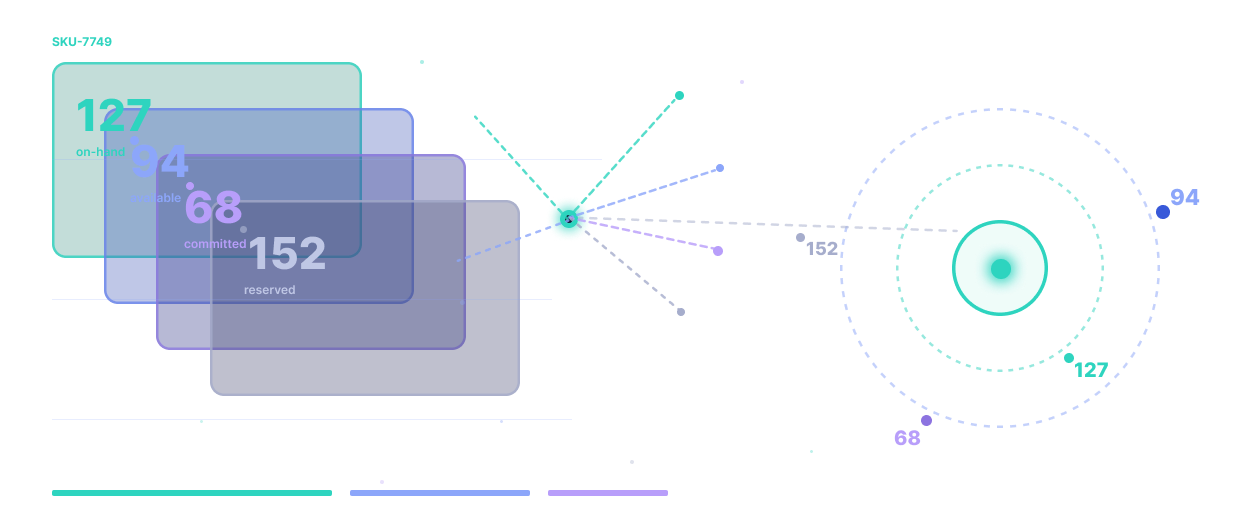
The language used by each system matters. Shopify, for example, distinguishes between on-hand, available, committed, unavailable, and incoming inventory. Those quantities are not interchangeable. A unit can be physically present and still be reserved, committed to an order, under quality control, or otherwise unavailable for sale.
Location adds another layer. Shopify tracks inventory independently across retail stores, warehouses, fulfillment apps, and third-party services. Stock held at one location is not automatically pooled with another location, and a product is only sellable from locations where it is active for fulfillment.
None of this is inherently an error. It is the reality of multi-channel, multi-location operations. Inventory drift becomes a problem when the team has to reconstruct that context by hand every time two numbers disagree.
More visibility can create more uncertainty
The usual response to fragmented inventory is another dashboard. But a dashboard does not resolve a disagreement.
If Shopify says 40 units are available, the warehouse says 58 are on hand, and a marketplace shows 31, the operator still needs to know:
Which number was updated most recently?
What operational event created the difference?
Which system should govern this particular decision?
Without those answers, more screens create more uncertainty—not more inventory trust.
The most damaging outcome is not always an immediate oversell. Often, it is hesitation. A buyer postpones a reorder because the forecast starts from a number they do not trust. A customer service representative checks three systems before answering a simple availability question. An operations manager begins another morning by reconciling yesterday’s inventory instead of planning today’s work.
After enough unexplained inventory drift, people stop trusting the first number they see. Every decision begins with the same quiet question: Do I believe this number, or do I need to check again?
When the discrepancy is specifically between Shopify and a fulfillment partner, there are several Shopify and 3PL inventory differences worth checking first, including inventory state, location, timing, and how each system represents availability.
The ad that never runs
Consider a common operator scenario: a brand pauses paid advertising because Shopify appears low on stock, even though the warehouse shows enough units on hand.
The difference could reflect a genuine shortage. It could also come from a reservation, a location rule, a receiving delay, or a recent adjustment that has not reached every system. If the team cannot reconcile those possibilities, the cautious choice may still be the wrong commercial choice.
Shopify notes that inventory quantities, active fulfillment locations, and location settings can affect whether an item appears out of stock and whether it might oversell. The lesson is not that every mismatch creates an oversell. It is that the team needs to understand what each number represents before acting on it.
The quiet business consequence
The visible symptoms of inventory drift are familiar: stockouts, overselling, delayed purchasing, fulfillment disputes, cancelled orders, and frustrated customers.
The less visible cost is the operating behavior that grows around uncertainty. Teams maintain extra spreadsheets, repeat manual checks, hold additional safety stock, and ask multiple people to confirm the same quantity. The workaround becomes part of the daily routine.
In SuppliFlex’s internal discovery research, all 13 interviewed operators raised the problem of cross-system inventory discrepancies without being prompted. Reported direct revenue-loss incidents ranged from $4,000 to $85,000, and operators reported holding 10–15% permanent safety stock because they did not trust their inventory numbers.
These findings come from a small, targeted operator sample, so they should not be treated as an industry-wide benchmark. They do show how inventory drift can affect both day-to-day decision-making and the amount of working capital a team is willing to lock into inventory.

Six questions to ask when inventory numbers drift
You do not need to replace every system before improving inventory trust. Start by making each discrepancy explainable and traceable. A structured inventory reconciliation process gives teams a repeatable way to compare records, investigate meaningful differences, and determine what—if anything—needs to be corrected.
1. What does each number represent?
Is it physical stock, available-to-sell

stock, committed inventory, incoming inventory, or a manually reconciled count? Two correct numbers can differ because they describe different inventory states.
2. When was each number last updated?
A quantity without a timestamp is not enough for a time-sensitive decision. Identify the latest confirmed update in each system before comparing the totals.
3. What event caused the difference?
Look for reservations, returns, transfers, receiving delays, damaged units, bundles, safety-stock rules, and manual adjustments. Inventory drift usually has an operational cause, even when that cause is not immediately visible.
4. Which system owns this decision?
The answer may vary by data type. A warehouse system may govern the physical count, while a sales channel governs what it can currently sell. Inventory trust does not require one system to control every decision; it requires clear ownership for each type of decision.
5. Can the correction be traced?
A new total is less useful if no one can see who changed it, when it changed, or why. Shopify’s inventory adjustment history illustrates the principle: inventory changes should leave an audit trail that helps teams investigate discrepancies.
6. Which exceptions need human review?
Not every small difference deserves the same response. Prioritize discrepancies that could affect a customer order, campaign, replenishment decision, or fulfillment commitment.
Trust before speed
When inventory numbers stop matching, the instinct is often to open another dashboard or export another spreadsheet. But more data does not automatically make the decision easier.
Operators need inventory signals they can understand and trust without rebuilding the story behind them every morning. That begins with clearer inventory states, timestamps, ownership, event history, and a consistent reconciliation process.
The next time two numbers disagree, pause before correcting either one. Ask what each number represents, when it was updated, and which event occurred most recently. The difference may come from a reservation, return, transfer, or delayed update rather than an incorrect physical count.
At SuppliFlex, we are continuing to research how multi-channel teams handle these moments and what makes an inventory signal trustworthy enough to act on.
When Shopify and your warehouse show different inventory numbers, which system does your team trust first—and why?